
Improve Your Putting Consistency With Counter Weighting
When most golfers think about custom Clubfitting, they think only of the full swing clubs – the driver, fairway woods, hybrids, irons and wedges. Few golfers are ever fit for their putter. Yet within this all important club exists the chance to achieve the greatest level of improvement on the golfer’s actual SCORE.
One of the most dramatic putting improvement tools within custom fitting has proven to be the use of a heavy weight inserted into the grip end of the putter shaft. This is a putter fitting technique called ‘COUNTER WEIGHTING.”
How does putter counter weighting work and what golfers will benefit?
Golfers who putt well have a high level of fine motor control skill. That means they have the neuro-muscular ability to move and control objects with their hands at slower speeds in a consistent, repeating and very precise manner. For those of us who do not have fine motor control, by putting a substantial amount of weight in the grip end of the putter shaft, the much heavier weight brought about by the presence of the counter weight is felt directly in our hands and the hands and arms are better able to move in a more consistent, repeating manner.
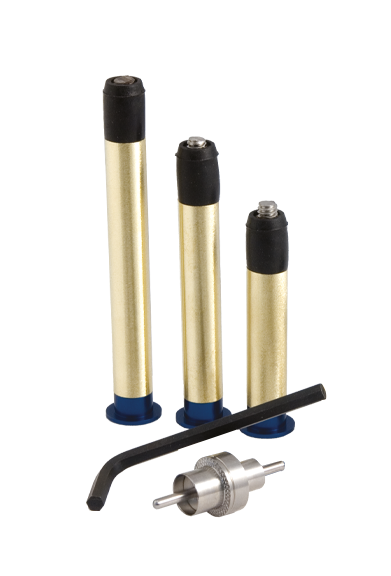
Golfers who have proven to improve their putting with a counter weight all have one or more of the following putting habits:
- Tendency to both pull and push putts off line
- A higher than average incidence of off center hit putts
- Inconsistency with distance control – some putts short and some putts long
- The path of the putter back and through the ball can be jerky, not very smooth and rhythmic
The most commonly used putter counterweights are the 60g, 80g and 100g weights, with the 80g and 100g counterweights being the most commonly used by most golfers for the putter. There is no question the chance of improved putting performance with a heavy counter weight in the putter is very high.
From speaking with clubmakers who offer this fitting service to their golfers and from our own work with golfers, we estimate the putting improvement rate for counter weights to be in the area of 75%, or three out of every four golfers that putts with a conventional putter and putting stroke.
If you’re interested in hitting putts more consistently and making more putts, go to the FIND A CLUBFITTER locator tool on the home page of wishongolf.com. Or better yet, click on this direct link to find a clubfitter near you who can install a counter weight in your putter – https://wishongolf.com/find-a-clubfitter/
Tom
Hi Tom, I have the new odyssey giraffe beam mini jailbird. Love the putters feel, but the stock grip is small in my hands (I used to have the larege superstroke on my scotty newport 2 and just loved it). My putter head feels heavy (and I like that), but I am thinking of upgrading my grip to the pistol 2.0 and adding weight… would you say go up to the 75g in the grip weight to offest the weight of the putter head?
JIMMY While putting a heavier grip on any club would make it read on a swingweight scale to have a lower swingweight, for most golfers the actual FEEL of the weight of the head won’t change when you put a heavy grip on the club. This is because the increased weight of the grip is not hardly ever felt to a golfer. Give you an example – I currently play with a Lamkin oversize grip that weighs 76g. With it on my clubs, the swingweight I prefer to use for a good head weight feel to me is C5. Now… Read more »
Hi Tom
I am looking to replace my old cord putter grip(68g) with a ping pp58(58g).
I am worried my putter will feel different with the 10g weight difference.
Should I add a 10g butt weight with the new grip to counter this problem??
Any thoughts are much appreciated. Thanks
MARK There is no single answer to your question because FEEL is such an individual thing. When it comes to feel, what one golfer notices, another doesn’t. I can only tell you to try it and go test hit many putts OVER TWO TO THREE DIFFERENT DAYS and see what you think. I will say that a 10g change in putter grip weight is very small, given that so many putter grips can be so heavy these days due to the big range in sizes and shapes and material from which they are made. Also, there is more of a… Read more »
Tom
Thank you very much for your insight. Truly appreciated. I will give it a good go. Thanks again.
Thank you Mr Wishon for all your equipment knowledge helping us hackers try to improve! I recently had a custom putter made that has a headweight of 368 grams in a Ping Anser 2D blade/mid-mallet shape. I struggled a little with short putts initially, but since adding a 50gm and now 75gm Superstroke countercore weight with a larger Pistol 2.0 grip it has worked much better. My long lag putts have also been much better. It seems as if the extra weight has calmed my stroke and hands and allows me to just use the weight of the putter to… Read more »
Robert Club weighting, whether on the grip or head end, truly is an individual thing for golfers. I’ve joked around a few times to the effect of saying that we can use a launch monitor to measure parameters that greatly help or even pin point what loft, shaft a golfer would do best with, but there is never likely to be anything like a “weight-o-meter” to give us accurate guidance on how much weight or where that weight needs to be to match perfectly with a golfer’s sense of FEEL for the weighting of his clubs. We teach clubmakers general… Read more »
Hi Tom, Just wanted to pick your brain on something, please, if you don´t mind. Do you think 10g in putter head weight is noticeable for a scratch golfer? I live overseas and I just had a putter custom made for me. Since I was lost on head weight, I chose 335g which seemed pretty standard to me and in line with the Scotty Cameron Newport Pro Platinum I own since the early 2000´s. I am now thinking it could be on the light side of things…do you think that a 345g head weight would have made a significant difference?… Read more »
Fabio from my experience, most, not all, but most scratch players would indeed notice a difference of 10g in the weight of the head of a putter. Most scratch players would notice a 4 to 5 gram difference. Some will notice even a 2-3g difference. But I do not believe a 10g weight difference would be considered to be very significant. Significant would be more like a 15-20g difference for most scratch players. Finding the best putter weight truly is a trial and experimentation process. There is no way that the best fitters on the planet can accurately guess what… Read more »
Thank you very much for your time, Tom. I agree with you; just have to try and it out, experiment, and see what feels best. As I noticed a 2g difference in my driver head weight, something tells me I would also notice something significant in my putter. I guess I just wanted a little reassurance, lol.
Thanks again for your attention!
Tom, I have an old Scotty that was 35” that I cut down to 33” with a lamkin jumbo grip, counter balanced. Put it on a swing weight and it’s only B4. Should I be worried about the SW being so light?
Adrian There is no right nor wrong when it comes to a swingweight on a putter. What IS Important is for EACH INDIVIDUAL GOLFER to ask themselves when using the putter, “CAN I FEEL THE HEAD ENOUGH DURING THE STROKE TO BE ABLE TO ACHIEVE DECENT PUTTING STROKE TEMPO AND STROKE CONSISTENCY?” That’s something that so very often is completely different for different golfers so you cannot just pick a certain swingweight to make your putter have. You have to go out and hit putts and sense whether you feel the head enough during the stroke or whether you can’t,… Read more »
Thanks very much Tom. Realizing I like the feel of more weight in my hands and need to ignore what the SW scale says.
Tom,
Quick question on the newer putter shaft technology like the Breakthrough Golf Technology Stability Shaft, replacing the steel shaft.
https://breakthroughgolftech.com/
This particular technology was invented by the creator of Adams Golf, Barney Adams. What is your opinion on a shaft that is more stable than steel? It costs $200 and I’ve seen unbiased fitter reviews that say it’s on to something and can really help improve your putting. It does add swingweight as it’s heavier toward the bottom.
Thank you.
Cliff
Different putter shafts of different weight? Sure, getting the weight feel of a putter is critical to putting stroke consistency. But a putter shaft with a stiffness or torque change to make the shaft more stable is nothing more than a marketing hooey intended to attract sales from golfers who are unaware that something like this cannot have any effect simply because of the extremely slow speed that a putter is swung. Stiffness or torsional design changes in shafts only begin to show up in performance as clubhead speed increases up to the point of full swing speeds.
TOM
Hi Tom, I’m getting a Sik DW putter that clocks in at 390g + 135g LA Golf shaft + 65g grip. I’ve been told that swingweight would be off the scale. If swingweight is that heavy, do you think that matters or is it still all about feel? Should I stop worrying about trying to get the swingweight into an E range? Does it all really matter with a putter?
CLIFF Putters will always forever be about individual FEEL and how that allows the golfer to achieve a smooooth, repeating stroke through the ball. For some that means a lot more weight in the grip. For others more weight in the head. And for someone else, a balance of butt and head weighting. While I wish there was a cool, slick. “feel-o-meter” tool that we could plug into each golfer to know exactly what kind of butt to head weight feel will generate the best, most consistent stroke results, unfortunately that is not the case so what’s required is a… Read more »
Tom, For years I struggled terribly with my putting. I particularly struggled with being shaky on short putts. I could not take the head back and through in a straight line. I went to the claw grip which helped some, but I was still a bad putter. I began testing counterbalanced putters with larger grips and began to find some improvement. I found a new putter I could aim well and began to customize weighting. The putter has a 377 gram head with an oversize 57 gram grip and a 50 gram butt end counterweight. With the bew putter I… Read more »
Michael When you look at counter weighting on a putter, you do have to look at the combined mass of the grip and the counter weight stuck in the butt end of the shaft. That becomes your key for any analysis of whether a different combination can help more or not with the idea you don’t want to go lighter in the combination mass. The other HUGE factor in this is what would be the effect of the SHAPE CHANGE of the heavier grip, if there is one. If your current 57g grip is of normal shape and size and… Read more »
Tom, Following up on my putter counterweight questions. Is there a difference between counterbalance and counterweight? My understanding is counterbalance utilizes heavier grip and heavier putterhead than normal to balance out. And Counterweight would be just weight in the grip. My specific question: If my grip plus drop-in weight insert under my hands is 86g grip + 57g drop-in weight, so total weight of 143g. My Scotty Cameron putterhead weight is 350g. I understand I need to base the putter fit on feel and i will do that, but do you like to see a certain minimum putterhead weight with… Read more »
CLIFF A counterweight is the object of mass used to counterbalance a golf club. It is not two different things. When trying to counterbalance a putter you need to factor in the mass of the grip with the mass of the counterweight together. When we talk about experimenting with a counterweight of either 80g or 100g we are talking about the counterweight itself only, not including the putter grip’s mass. And we are considering the putter grip as a baseline to be around 60-65g. So if you use one of these heavier putter grips such as the 83g grip you… Read more »
Tom, do you consider 350g putterhead weight to be heavy enough to counterbalance that much grip weight? What is your typical putterhead weight you usually like to start with as a minimum when beginning the counterbalance process? I’m just thinking the 350g might be too light.
CLIFF These days a putter head weight of 350g is very normal. 15 yrs ago and before normal was 335 grams but most companies chose to up the standard headweight of their putters to the 350g level. Very very seldom in our testing with counterweights about 5-6 yrs ago, very seldom did we ever find a golfer who had to have more weight put into the head when they were using a total of 140-170g in the combination of grip and counter weight. The reason is because the whole purpose of counterbalancing a putter with a lot of weight on… Read more »
Is counterbalance in a putter ONLY the weight added to the shaft or under the grip? Or is it the total weight of the grip and other weight added? So when you say above that in most cases, anything over 100g was not effective, you only mean the added counterweight and NOT the grip, correct?
CLIFF It is true that once a player begins to use any of the really large and very heavy putter grips currently available, he is then pretty much doing the same thing as using a counterweight in the end of the shaft. The reason we felt that so many golfers seemed to benefit from an 80-100g counterweight in the putter was simply because it puts more weight directly in their hands which can help calm down the hands and arms to be able to make more consistent repeatable strokes with the putter. So in this sense, weight is weight in… Read more »
Tom,
In your opinion what would cause a consistent slight miss to right on flat putt. It’s never left. I’m 5 foot 11 and right-handed. I have 2012 Newport 2, 1° loft, 69° lie, 350g head, 51g smaller SuperStroke Flatso 1.0 grip w 57g counterbalance drop-in weight inserted into shaft. I’m sure it could be the stroke, but anything else stand out for it to be something else? Like grip too small, putter too long, lie/loft off, too much weight on either end, etc. I’ve had fittings to get to this, just seeing your thoughts. Thank you.
And I’m going to cut the putter down to 34.5 so factor that in. Thanks.
Sorry, I had a follow-up here and it must not have submitted. I was asking if there is a point where too much counterbalance weighting is a bad thing. I understand you have to try it to see but before I go replacing grips and installing new grips, is there a point you look at it and go that’s not good. Say in the above scenario with my 35-inch 350g putter head…..I cut it to 34.5 inches and change to 87g grip. So now total counterbalance weight in my hands has gone from 108g to 144g. Grip from 51g to… Read more »
Cliff So little is known about the effects of counterweighting full swing clubs that it is impossible to answer your question definitively. From the work I did some years back I would be comfortable with saying that there is no one counterweight amount that could be considered to be good or bad for any golfer. This is because when it comes to weight distribution on golf clubs, every golfer can be different in terms of what they sense to be too light, too heavy, about right or effective or ineffective. All of us are built differently in terms of what… Read more »
Cliff With putting it is not the same in terms of being able to track specific swing characteristics vs fitting parameters to predict results. This is mainly because the putter is swung so slowly compared to the other clubs. I would take a guess to say that consistent pushes could be caused by either, 1) the lie angle being too flat for your set up and stroke; 2) the putter head possibly being a little too head heavy for you and your stroke; 3) the putter possibly being too long for you and your most comfortable set up position. Hope… Read more »
Hey Tom! I know this is an old thread but is the counter balance you are talking about here with the heavy weight being placed above the hands or in the hands? I put with a standard 34.5” putter. Would i need to lengthen the putter some and add the weight above my hands to see benefits? Or can i just add the weight straight in to my 34.5” putter to see benefits? Im looking for increased feel for improvingg distance control mainly. Any advice would be great!
CHAD The counterweights we sell are intended to be installed into the very butt end of the shaft. There is a lip on the end of each counterweight to prevent it from falling down into the shaft. There is a hex nut in the end of each counterweight that you dial to activate a little cam device inside the counterweight that locks the cwt inside the shaft. You can put the counter weight into the end of the shaft either before you install the grip or afterward. If you do it before you install the grip you lock the cwt… Read more »
I have a Scotty Cameron Golo7 Dual Balanced 38 length putter. I would like to cut down the shaft and make it 34 length and install a heavier grip instead of the one that came with the putter. Will the difference in the shaft length when I reduce it from 38 to 34 make the putter too heavy? Will I ruin the putter if I do that?
Why not leave it at 38″? My 38″ putter doesn’t quite reach my belly, and I grip at 32″ With 75 gm in the butt it is perfectly counterbalanced for me.
If you cut to 34″ it will make the head seem much heavier, and will require a lot more counterweight to balance. And at 34″, there may not be enough lever arm above your hands to counterbalance at all.
When you cut down any club to a shorter length it will make the head feel lighter. When you lengthen a club it will make the head feel heavier. Thats why Scotty Putters have increasingly heavier weights in the head the shorter they are.
What you are feeling when you cut the length shorter on ANY GOLF CLUB is that the club now has a substantially lower moment of inertia. And conversely when you lengthen a club, its moment of inertia is much higher. I’m talking about the MOI of the fully assembled club here. This is because length is a squared property in the calculation of the MOI of a club – MOI = Length2 x weight. You can add weight back to the head of the shortened club to increase the MOI but you would have to add a LOT of weight… Read more »
MIKE The act of putting and putter fitting is SO individual and so subject to subjective intangibles of golfer feel and sensation that it is impossible to predict the outcome of any putter change on any one person’s performance with the putter. This truly is an area of “one man’s feast is another man’s famine” when it comes to fitting and equipment performance. So much of proper putter fitting is trial and experimentation because there are just no ways to empirically measure a golfer’s perception of feel as it applies to smoothness and consistency in the stroke. Typically, cutting a… Read more »
Hi Tom, Tom, you give excellent advice on counterbalancing weights in putters.I have bought a Odyssey Black Series Tour design blade putter.It is a 35″ model and I usually play with 34″ putters.With these stock putters,the 34″ putter heads weigh 350 grams and the 35″ heads heads weigh 340 grams.I would like to cut my putter down 1″ to the 34″ length.First of all, would you recommend I cut the 1″ off to more suit my length preference? I want to try counterbalancing my putter. I like the Super Stroke 2.0 grips which only weigh 50 grams ( probably close… Read more »
MARC: Always happy to help. Everyone’s putter length is a completely individual decision to make, with the key requirement being comfort over the ball for how much you bend over in your set up, and to make sure your arms are not scrunched up nor stretched out too much. You can get a feel for your length without any putter in your hands, but with a 2nd person to do a measurement. Bend over into your most usual and comfortable posture that you use in putting with your eyes directly over a golf ball on the floor. Just let your… Read more »
Hi there.
Is the counter weight weight relative to the weight of the putter head? If the head is heavy, and with scotty you can adjust the weight, do you need heavier weight or do you buy a kit that you then find your own balance?
James No, the counterweight mass has nothing to do with the weight of the head. If I had to put a proviso on the mass I would say very roughly speaking that the worse the golfer is for distance control + off center hits + push/pull tendency, the heavier the counterweight could be to help calm down the stroke more to offer improvement. That being said, we have seen much more success with either an 80 or 100g counterweight than with a 60g. And 40g is too light, while over 100g tends to get to be too heavy for most… Read more »
Tom, You have been very helpful in previous questions answered so I send another one your way. Is there a general ratio of butt end weight to headweight that has been found to most positively impact the highest degree of golfers? I have tested a high MOI putter with a 350 gram head and a 54 gram Rosemark 1.52 grip. On most days the weighting is fine. On my shakiest days it does not help smooth my swing, something I have consistent trouble with. My misses cover all your reasons for the need for counterbalancing. A very experienced manufacturer’s fitter… Read more »
Michael No there is not any such investigated ratio of weight on one end of the putter vs the other. The fitter you reference is right. We began messing around with research into counterweighting putters about 5 yrs ago and found that a very high percentage of golfers can calm down the stroke action to be more consistent and repetitive with the stroke with an 80 or 100 gram counterweight in the very butt end of the shaft. 50g is too light, believe me. We tested everything from 12g to 150g and found that the vast majority reacted positively to… Read more »
Tom, Thank you so much for the reply. So, I am slightly confused. In one statement you write that the fitter is correct. I assume you are referring to him suggesting an increase in hand weight 30 grams to 380 grams and in grip end weight 50 grams to 107 grams total, grip plus counterweight. But then you wrote 80-100 grams of additional butt weight with no adfitional head weight is what is needed to quiet hands. I am probably misunderstanding, but can you help clarify it for me? I have had some previous success with heads around 365-370 grams… Read more »
I only meant that the fitter was correct in terms of talking about a counterweight. From that I led into talking about our experiences and told you what counterweight amounts worked best and that there is no need to change the headweight. So your fitter is wrong about the 50 grams + add headweight in terms of what we found from our extensive research work with many golfers. BUt he was right in at least just bringing up the use of a counterweight.
TOM
Michael,
I would suggest that you hold the putter at your normal length with two fingers. Swing it above the turf lightly as if putting. Observe how far the head swings past your hands. Then putt. Experiment with various “excess swing distances” until your putting is consistent, particularly for longer lag putts. Keep that weight as your preferred weight.
In my case, I found that if the head just slightly passes my hands, it’s just right.
Ted
I thank everyone very much for the responses! I respect them very much!
Tom,
Quick question on putters. With all your experience, have you concluded what types of sight lines/sight dots (or no lines/dots) work best for the average putter? I know it’s probably what makes the person feel better but wondering your opinion. I’m thinking of going from one sight line to three sight lines and a dot on an answer-type putter. Thank you for your time.
CLIFF There is no question that one set up of alignment lines on a putter cannot possible work well for all golfers because there are definite differences in people’s eye dominance and other eye related factors that affect how people see things. There have been PGA Tour players who have sought out analysis from eye specialists to determine this, so they could then have their sponsoring company make the alignment lines on their putter so it corresponds to how they see things. I know Tom Kite was one who did this in the past when he was playing the regular… Read more »
Thank you for all your time and answers to everyone’s questions. So interesting to read. If my 35-inch 2016 Scotty Cameron Newport 2 putter started with 2x10g weights (new) and I can experiment with adding 2x15g, 2x20g, 2x30g or 2x40g weights, will using a 50g putter grip with an additional 50g weight in it (this is how Superstroke does it, so total putter grip weight of 100g) just cancel out the weight I increased in the putter head? I’ve always thought I like a heavier putter head, but up above in one of the responses to you, someone realized they… Read more »
CLIFF When you put weight in the very grip end of the putter and leave the head weight as it is, you still feel the presence of that headweight because the grip end weight is laying right in your hands, while the headweight is still out there dangling at the end of the shaft around 30 something inches from your hands. So the head weight can still exert its feel influence on your overall sense of feel. Were you to add weight anywhere below the hands, it would affect the head weight feel more dramatically. Whether that ends up feeling… Read more »
Tom, thank you very much. One last question, will the normal 10-15 handicap notice a 15g difference in grip weight, going from 85g to 100g (If the putter head-weight of 360g stays the same)?
CLIFF More than likely not and that includes players better than a 10-15. 15g on the grip end is a very small amount of weight which falls into the insignificant category. However, there can be a person here and there who just happens to have a more refined sense of feel. But I would say if you lined up 100 golfers you might find one or two maybe who might feel a difference from 15 g. When we talk about putter fitting and using counterweights in the butt end to help improve putting consistency, our research showed that the vast… Read more »
Tom, I made a big mistake this year thinking a switch to a wider Newport 2-like putter would help me even though I was already a pretty good putter. I got a Bettinardi Kuchar 1 wider putter, beautifully made, but results were not good. And to compound, I sold my old Newport 2 putter. So I just got a 2016 Newport 2 with 2x10g weights (my old one had 2x15g weights). I se a 85g Flatso 1.0 putter grip. Now these come with an optional 50g weight for inside the putter grip. Since my putter head is now 10g lighter,… Read more »
CLIFF
No one but you can determine whether to use the 50g grip weight or not. There are no measurements, no devices that exist with which anyone could detect what a golfer’s best weighting for consistency would be. weighting can only be determined by trial and experimentation over some time. So you’ll have to putt for a while with the 50g weight in the grip and without it and then think about which one allowed you to be more consistent in distance control, pull/push tendency and off center/on center hit percentage.
TOM
Thanks Tom
It’s good to speak to someone who is willing to offer independent advice willingly in order to increase the knowledge of golfers world wide.
Thanks again
Peter
Peter
Thanks for you interest for sure. The reason I have always done this in my career is because there is so much misinformation out there which can be so misleading to golfers who simply want to know the facts. I know this stuff better than any one now because I have been digging deep into it for some 40 yrs chiefly because I wanted to know the answers. Glad to help anytime.
TOM
Thanks Tom,
Great answer as usual.
Having read your answer I can probably guess your answer to the next question.
Have you any evidence that counterbalancing helps delay the release for players with an early release?
PETER There is no 100% association with this, but we have seen some golfers be able to hold the wrist cock angle a little longer with counterweights, typically in the 30g to 40g level more than with the 12 to 20g level. But we’ve also seen golfers with an early release keep that same early release with a counterweight as well. I can say from several years of studying the relationship of the swing to fitting that the body has an amazing ability to overcome/offset/counteract certain changes in golf clubs but not others. For example, if a golfer changes from… Read more »
Hi Tom I am in the process of having a set of 771 CSI’s fitted and built. I find the technical side of golf to be as interesting as attempting to build a good swing. I am interested in the concept of counterbalancing the irons. I am 6′ 2″ and weigh approx 260lbs My ss with a 6 iron is 74-76mph I have a reasonably smooth swing with an early to mid release Could you tell me what the possible benefits of counterbalancing may be and what sort of weight would be a sensible starting point? Have you done any… Read more »
Peter Thanks very much for your message and we are always glad to help with any information we can from our work. Yes, we have done quite a bit of work in testing with counterweights in the butt end of woods, irons and putters as well. First off, no question that for golfers who suffer from putter problems such as poor distance control, push/pull tendency and off center hits with the putter, using a heavy counterweight in the end of the putter, such as a 60, 80 or 100g counterweight shows definite improvement in at least 70-80% of those golfers.… Read more »
My 9 year old son uses an adult putter cut down to 28 inches. Does cutting it effect how it plays and would an adjustment need to be made, perhaps counterbalancing? Thanks
Geoff: with regard to cutting down a PUTTER for use by a junior, the key things are going to be, 1) getting the length just right for his size and posture over the ball, 2) adjusting the lie angle of the putter so the head sits flat on the green in the center of the sole without the toe or heel sides of the head tilted up – most putter heads are eligible to be bent to adjust lie if they have a conventional stem type hosel. Those that have a single or double bend steel shaft inserted directly into… Read more »
Hello Tom,
Thank you very much for answer us all. A couple of years ago one asked you here if the weights within the shaft, more in the middle, than at the grip end was useful. Back then you didn’t have it clear. Lacking experience you said.
In my putter I want to put the counterweights, but Tour Lock has two different solutions: Weights at the grip end or the opti-vibe that gets deeper (about 7 inches recommended).
Two years later, What do you recommend?
Thanks in advance,
Albert
Albert: When it comes to PUTTERS, I feel strongly from our experience that the counterweights should be in the very grip end of the shaft, not in the middle areas. The reason the counterweighting works to calm down the putting stroke is by putting a substantial amount of additional weight right in the hands of the golfer. Putting the counterweight in the very end of the shaft puts it right where the hands are on the grip. I still have not done any other research with mid shaft weighting because I just have not had the time nor the inclination… Read more »
Tom,
I have a set of Ping i20 with Steelfiber 70cw a-flex, I’m thinking of countebalancing, should I try with ~40g and see, I’m 67 years and plays of 6 hcp, my 6i is 72mph, slow/moderate swing. One problem is that Steelfiber has a smaller insert than steel, how do I handle this.
Bjorn: If you know for sure that the inside diameter of the shafts you have is too small to accept the counterweights such as we offer, then your only alternative will be to go to a hardware supply store and look for an item called a CLEVIS PIN. Clevis pins are solid steel plain bolts that should be small enough to insert into the butt end of the shaft. They do tend to come only in one size, which means one weight only. So to get to whatever weight you desire to experiment with counterweighting you would have to either… Read more »